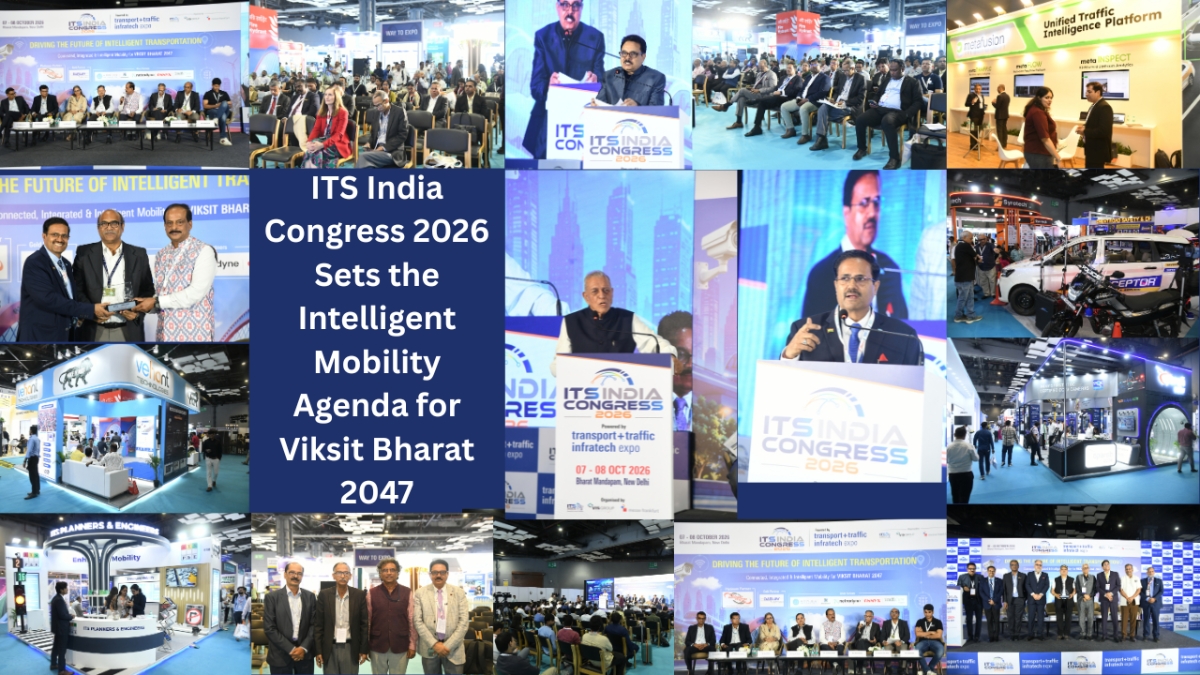
Two-day national convening at Bharat Mandapam unites government, industry, academia and global ITS leaders behind four national roadmaps for connected, integrated and intelligent mobility
New Delhi [India], October 10: ITS India Congress 2026 concluded at Hall No. 1, Bharat Mandapam, after two days that brought policymakers, regulators, industry leaders, researchers and international ITS bodies onto a single platform. The question before them was national in scale: how can Intelligent Transportation Systems accelerate India’s journey to Viksit Bharat 2047? The answer was consistent across sessions: electronic enforcement, connected infrastructure and a skilled workforce, delivered together.
Organised by ITS India Forum under the theme Connected, Integrated and Intelligent Mobility for Viksit Bharat 2047, the Congress made a clear case: technology is no longer optional in India’s mobility future. It is the foundation. Across five thematic sessions, a closed-door global roundtable and a valedictory programme, delegates moved beyond debate towards a defined set of national roadmaps, with road safety as the common thread.
- 2 days of deliberation
- 5 thematic sessions
- 4 national roadmaps
- 1 global leadership roundtable
A national call to action
Shri Mahmood Ahmed, Additional Secretary, MoRTH, set out the ministry’s blueprint for intelligent highways, placing electronic enforcement and Multi-Lane Free Flow (MLFF) tolling at the centre of safer, technology-led implementation.
“Electronic enforcement is central to road safety. With SOPs in place, the priority is installing equipment at strategic locations. MLFF and electronic enforcement must harness technology to deliver effective implementation.” — Shri Mahmood Ahmed, Additional Secretary, MoRTH
Shri Sanjay Bandopadhyaya (Retd. IAS), Member, Supreme Court Committee on Road Safety (SCCoRS), made the case for using technology to halve road deaths by 2030, with safety never traded for efficiency.
“The central purpose of ITS is to raise efficiency in transport and logistics, with road safety never compromised. Four Es define the mission: Enforcement, Education, Engineering and Emergency Care.” — Shri Sanjay Bandopadhyaya (Retd. IAS), Member, SCCoRS
Prof. K. K. Aggarwal, President, South Asian University, spoke on building India’s ITS talent for 2047 and on the central role of ITS India Forum in that mission.
“Transport has always been a catalyst for development, and ITS is where technology meets transport. Electronic enforcement is the only option, and the full involvement of ITS India is instrumental for #ViksitBharat2047.” — Prof. K. K. Aggarwal, President, South Asian University
State leadership offered the view from the field. Smt. Malini Aggarwal, IPS, Director General of Police, Rajasthan, addressed AI-led and digital enforcement for safer roads, and the need to connect data held in silos.
“Technology can transform road safety, from predictive hotspot mapping to early identification of accident-prone areas. Siloed data must be connected. Only then can it protect lives.” — Smt. Malini Aggarwal, IPS, Director General of Police, Rajasthan Police
Ms. Lee McKenzie of ITS New Zealand delivered the international keynote on global lessons for India’s 2047 leap.
“Transforming India for #ViksitBharat2047 demands a vision to lead globally, and digital infrastructure must anchor that vision. The world is watching India as a pillar of development: economic, social and environmental.” — Ms. Lee McKenzie, ITS New Zealand
Industry perspectives came from Mr. Debashish Debsikdar of Jio Platforms, on 5G in tolling and traffic, and Mr. K. K. Kapila, President Emeritus, IRF, who called for resilient, climate-ready infrastructure and a shift from reactive to predictive safety.
“We are moving from reactive safety to predictive safety. The vehicle is becoming intelligent. The road is becoming intelligent. Now they must talk to each other. Infrastructure must be resilient, and climate change demands serious attention in how we build it.” — Mr. K. K. Kapila, President Emeritus, IRF
The First ITS India Year Book 2026 was launched at the Congress. International partners recognised the Forum’s role as a convenor for the mission of road safety.
“ITS India Forum has united stakeholders behind one mission: road safety.” — Ms. Susan Harris, CEO, ITS Australia
Five sessions, one national agenda
• Citizen-centric mobility. Chaired by Prof. K. K. Aggarwal, President, South Asian University, the session examined AI-enabled traffic management, predictive safety analytics, ANPR and the e-challan ecosystem. Presentations ranged from AI for seamless metro-to-doorstep journeys (DMRC) and risk-led enforcement (Datacorp Traffic) to video analytics (Sensen Networks) and next-generation AI traffic control from ITS Singapore. Intended deliverable: the ITS Roadmap for Citizen-Centric Mobility and Viksit Bharat 2047.
• Barrierless tolling and mobility finance. Co-chaired by Shri A. R. Chitranshi, COO, IHMCL, the session charted the transition from FASTag to MLFF, alongside GNSS-based tolling, congestion pricing and sustainable infrastructure financing. ITS Australia, e-con Systems and FETC shared global experience. Intended deliverable: the India Road User Charging and MLFF Roadmap 2047.
• Connected mobility. Chaired by Dr. N. Subramanian, ED, SETS, the session explored V2X and C-V2X, 5G and edge computing, connected corridors, cybersecurity and spectrum. Danlaw Technologies and MeitY presented, with the panel including Netradyne and C-DAC Bangalore. Intended deliverable: the India Connected Mobility Roadmap 2047.
• Integration and logistics under PM Gati Shakti. Chaired by Mr. Anil Chikkara, [designation to be confirmed], the plenary addressed multimodal integration, digital rail, electric highways for greener freight and smart logistics systems, with voices from Hitachi Rail, NHEV, MoRTH, RailTel and CSIR-CRRI. Intended deliverable: the National Multimodal Mobility and Logistics Roadmap 2047.
• Capacity building. Chaired by Prof. Manoranjan Parida, IIT Roorkee, the session tackled the ITS workforce, quality assurance, standards and interoperability. Speakers from STQC, CSIR-CRRI, ITSPE and NATRAX joined the session, while presentations from South Asian University and ITS India Forum focused on climate-smart ITS and a national talent pipeline. Intended deliverable: strategies for a skilled, future-ready ITS workforce.
From deliberation to roadmaps
Each of the first four sessions was designed to yield a defined national roadmap, and the capacity-building session was charged with a workforce strategy. Together, these outputs give policymakers and practitioners a coherent framework for deployment at scale, aligning enforcement, tolling, connectivity, logistics and talent to one national agenda.
A closed-door Global ITS Leadership Dialogue Roundtable, chaired by Shri Gaurav Upadhyay, IPS, Secretary, Transport Department, Government of Assam, and moderated by Shri Akhilesh Srivastava, President, ITS India Forum, brought government officers, global ITS leaders and industry associations into candid conversation on the road ahead.
The Congress closed with a valedictory session that presented the two-day summary of deliberations and outcomes, followed by an Award Ceremony recognising the solutions selected at the NRSTC Conclave held at IIT Bombay on 25–26 August. The awards celebrated innovation that moves road safety from concept to deployment, and reinforced the Congress message that implementation, not intent alone, will define India’s road to Viksit Bharat 2047.
The breadth of participation reflected the maturity of India’s ITS ecosystem. Central and state governments, enforcement agencies, public-sector enterprises, research institutions, global ITS associations and industry innovators shared one platform, an alignment essential for interoperable, nationally scalable deployment.
With the roadmaps now defined, ITS India Forum will work with government, industry, academia and international partners to translate recommendations into action, building the institutions, standards and talent that Viksit Bharat 2047 demands.
“This second edition of ITS Congress is scaled to a new level. Road safety is an urgent national priority, and ITS must play a central role in addressing it.” — Shri Akhilesh Srivastava, President, ITS India Forum
About ITS India Forum
ITS India Forum is India’s national think tank for Intelligent Transportation Systems and smart mobility, bringing together government, industry, academia and international partners to advance safe, sustainable and efficient mobility.
If you object to the content of this press release, please notify us at pr.error.rectification@gmail.com. We will respond and rectify the situation within 24 hours.